
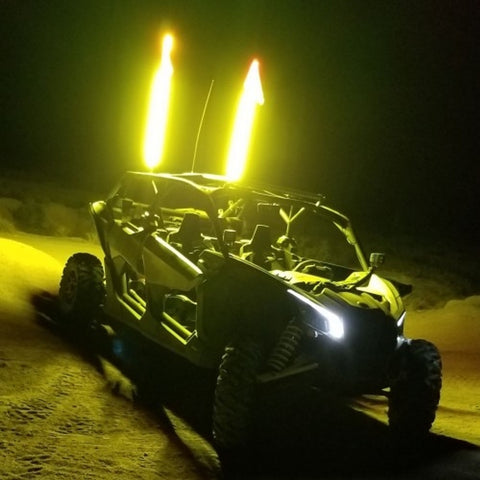
Best UTV Light Ba...
Sep 18, 2026

If you ride at dusk, on unmarked trails, or in a group, visibility isn't optional - it's survival gear. LED whip lights have become one of the fastest-growing accessory categories in the UTV world for exactly that reason: they make you seen, they make your rig look incredible, and in a lot of states, they're required by law for off-road registration.
This guide breaks down everything you need to know before buying a set - from brightness and waterproofing to which style fits your specific machine.
An LED whip light is a tall, flexible antenna-style pole with LED lighting embedded along its length, mounted to the front or rear of a UTV. Unlike a standard light bar that throws light forward, a whip light's job is to make your vehicle visible from a distance and from multiple angles - especially useful in dust, sand, or wooded terrain where line-of-sight is limited.
Most modern whips also double as a safety flag replacement, since the bright, tall profile is easier to spot over dunes or ridgelines than a traditional flag alone.
Whip lights solve three problems at once:
Visibility to other riders - critical at dusk, in dust clouds, or on blind hill crests
Group coordination - many riders use different whip colors to identify their vehicle in a pack
Style - RGB whip lights have become a signature look in the UTV community, often synced to music or set to custom patterns for shows and meetups
If you ride in a group or anywhere with limited visibility, this is one of the highest-value upgrades you can make for the price. Pair a set of whips with a good light bar or auxiliary mount setup and you cover both forward visibility and all-around presence.
Not all whip lights are built the same. Before you buy, compare these factors:
Brightness (lumens): Higher lumen output matters less for the whip itself and more for the base/accent lighting some models include
Pole material: Fiberglass-core whips flex and recover their shape after branch strikes; cheaper solid plastic versions can crack
Light density: More LEDs per foot means a smoother, more even glow rather than visible individual dots
Control method: Bluetooth app control, remote control, or a simple on/off switch - app control is more flexible for changing colors and patterns on the fly
Mounting hardware: Confirm the base is compatible with your vehicle's mounting point (many use a universal 3/8" thread base)
Single whip setups are the more budget-friendly, minimalist option - one light mounted typically on the front passenger corner. They meet most state visibility requirements and suit riders who want the safety benefit without the higher cost.
Dual whip setups (one front, one rear, or two front) give 360-degree visibility and a more balanced look, especially on longer wheelbase machines like the Can-Am Defender or Polaris Ranger crew models. Dual setups are the standard choice for group riders and night trail use.
Solid color whips (typically white, amber, or red) are simpler, more affordable, and use less power - a good fit if you mainly care about visibility and don't need the extra features.
RGB whips let you cycle through millions of color combinations, sync patterns between multiple whips on the same vehicle, and often include music-sync modes for shows. They cost more and typically require a companion app, but they've become the go-to choice for riders who want their UTV to stand out at meetups.
This comes down to how and where you ride:
Flexible (fiberglass core) whips bend under wind, speed, and branch contact, then spring back - ideal for wooded trails, tight courses, or high-speed dune riding where rigidity would snap a pole
Rigid poles hold a straighter profile and can look cleaner for show setups, but are more prone to damage on technical trails with overhead branches
For most trail and dune riders, a flexible fiberglass-core whip is the safer long-term investment.
Since whip lights are mounted externally and exposed to mud, rain, and water crossings, waterproof rating matters more here than on almost any other UTV accessory. Look for an IP67 or higher rating, which means the light and control box can handle submersion in shallow water and heavy spray without failing. Avoid unrated or vaguely labeled "weather-resistant" listings if you ride in wet conditions regularly.
Whip lights typically range from 2 to 6 feet. Taller whips (5–6 ft) are the standard for dune riding, where visibility over rolling terrain from a distance is the priority. Shorter whips (2–3 ft) suit tighter wooded trails where a tall pole is more likely to catch on branches. Check your local off-road area's rules too — some dune areas have minimum whip height requirements for safety.
Installing LED whip lights is a straightforward weekend job for most riders:
Choose a mounting location with a clear, unobstructed view from the front and sides of the vehicle
Route wiring away from moving parts, exhaust heat, and pinch points before securing with zip ties
Connect to a switched power source (not always-on battery) so the lights don't drain your battery when parked
Use dielectric grease on all connections to prevent corrosion from moisture
Test the full range of motion before your first ride to confirm the whip doesn't contact the roll cage or roof
RZR models have relatively narrow bodies, so front corner mounting near the A-pillar works well for maximizing visibility without obstructing the driver's sightline.
With its longer bed and utility layout, the Ranger benefits from a dual setup — front for oncoming visibility, rear for anyone approaching from behind on trails or farm roads.
The Defender's wider stance and factory light bar options pair well with color-matched RGB whips for a coordinated look, particularly on Defender X mr trims already built for trail use.
As a dune and high-speed sport model, the X3 is one of the best candidates for tall (5–6 ft), flexible fiberglass whips that stay visible at speed without compromising handling.
The Talon's sport-utility profile suits a single front whip for riders prioritizing weight savings and a cleaner look, or dual whips for those running night trails regularly.
Built for technical, rocky terrain, the KRX benefits most from shorter, more flexible whips that can absorb contact with overhead branches on tight trails.
A versatile trail machine, the Wolverine works well with mid-height (3–4 ft) whips that balance visibility with maneuverability in wooded terrain.
Rinse mounting bases and connectors after muddy or wet rides to prevent corrosion buildup
Check zip ties and wire routing periodically for wear from vibration
Store the vehicle with whips in the upright position when possible to avoid prolonged bending stress
Inspect the base thread and mount for cracking after any hard branch strikes
Requirements vary by state and by the specific off-road area. Many managed dune and trail systems require a visibility flag or whip light of a minimum height, so check local regulations before your first ride.
Wiring them to a switched accessory circuit, rather than a constant power source, prevents battery drain when the vehicle is off.
Yes - they serve different purposes. A light bar illuminates the trail ahead, while whip lights make your vehicle visible to others. Most riders run both.
With a quality fiberglass core and proper wiring, a well-maintained whip light can last several riding seasons before the LEDs or internal wiring need replacement.
LED whip lights are one of the most practical upgrades a UTV owner can make - improving group visibility, meeting trail safety requirements, and adding a distinctive look to your ride. Whether you're outfitting a Polaris RZR for dune days or a Can-Am Defender for trail work, matching the right height, flexibility, and waterproof rating to your riding style will make the difference between a whip that lasts and one that needs replacing after a season.
Browse our full selection of UTV whip lights to find the right fit for your machine.

Sep 18, 2026

Sep 16, 2026

Sep 12, 2026
